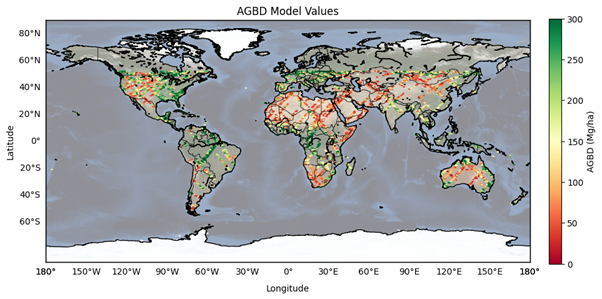
On Tuesday, March 12, at 12:00 Ka Hei Chow will present her master thesis on ” CNN-based Global Aboveground Biomass Estimation using Sentinel-2 and GEDI” in seminar room 3, John-Skilton-Str. 4a.
Abstract: Accurate global estimation of aboveground biomass is essential for sustainable forest management and climate change adaptation planning (FAO, 2020). Existing global biomass products lack gap-free information with high temporal and spatial resolution, limited by its complexity regarding climate zones, tree species and topography (Y. Zhang et al., 2019). This study explores the viability of a proposed deep-learning approach for estimating global biomass using Sentinel-2 and GEDI data. The goal is to create a continuous gridded data layer at 10 m resolution representing biomass distribution worldwide. Employing a ResNet-based CNN model for regression, we experiment with the integration of ancillary datasets such as land cover, elevation, and climate information, achieving an average RMSE of 81.4 Mg/ha and MAE of 36.1 Mg/ha. Our model demonstrates the potential of CNNs for large-scale biomass estimations even in the absence of sufficient field data. The optimum model combines Monte Carlo dropout with ESA WorldCover, COP-DEM elevation data, and geo-coordinates, underscoring the importance of the latter two integrations in fortifying model robustness. A methodological limitation arises from data saturation in Sentinel-2 imagery, particularly evident in high biomass forests, leading to underestimated values. Furthermore, additional uncertainty is observed in mangrove forests and under-represented regions.
1st Supervisor: Dr. Martin Wegmann
2nd Supervisor (external): Dmitry Rashkovetsky, Orora Tech
![[Spotlight] Lecturer Spotlight: Julian Faeth](https://eagle-science.org/wp-content/uploads/2026/10/Julian_Faeth_EORC_EAGLE_2026-400x250.jpg)