
Most remote sensing work happens in the daylight, at a desk or in a field with a drone. Jolien Grafe, one of our EAGLE M.Sc. students, spent a good part of her internship doing the opposite: sitting on a hill at dusk, listening for a beeping signal from a very small, very secretive cat.
Jolien joined the Black-footed Cat Working Group at Benfontein Nature Reserve near Kimberley in South Africa. The project is run by Cologne Zoo and focuses on the black-footed cat (Felis nigripes), a threatened species that is still poorly studied. Conservation and behavioural research go hand in hand here, because you can’t protect an animal well if you barely know how it lives.
Her work had two sides. The first was pure data wrangling. Over three decades, different people have collected GPS tracking data on these cats, and it all lived in several hundred separate datasets. Jolien pulled them together into one database, which is the kind of unglamorous job that makes everything afterwards possible. On top of that she ran first home range analyses, so the group now has a clearer picture of how much space these animals actually use.
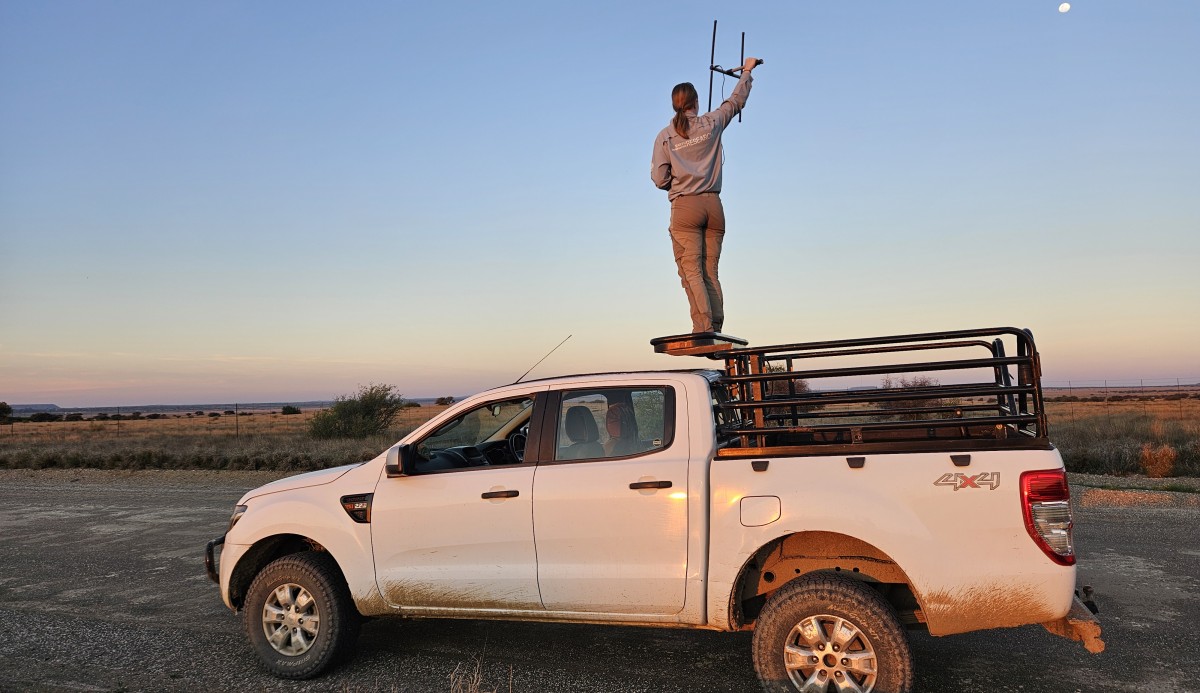
The second side was the tracking itself, and that’s where it gets fun. The cats wear VHF collars, they’re active at night, and during the day they sleep in various burrows. So the routine starts in the evening. Jolien and the team climb a koppie, or the roof of the car when there’s no hill nearby, to get as high as possible and pick up a signal from far away. Once they have a direction, they drive over, find the animal, and then follow it for several hours through the night.
In the daytime, they sometimes set up camera traps in front of the burrows, but only if they manage to work out which one the cat is in. And that’s easier said than done when the animal is sleeping deep underground.
It’s a nice reminder that earth observation isn’t only about satellites and sensors. Good spatial data starts with someone patiently standing in the dark with an antenna, and good analysis starts with someone cleaning up thirty years of files. Jolien did both.
Thanks to the Black-footed Cat Working Group and Cologne Zoo for hosting her.
Jolien joined the Black-footed Cat Working Group at Benfontein Nature Reserve near Kimberley in South Africa. The project is run by Cologne Zoo and focuses on the black-footed cat (Felis nigripes), a threatened species that is still poorly studied. Conservation and behavioural research go hand in hand here, because you can’t protect an animal well if you barely know how it lives.
Her work had two sides. The first was pure data wrangling. Over three decades, different people have collected GPS tracking data on these cats, and it all lived in several hundred separate datasets. Jolien pulled them together into one database, which is the kind of unglamorous job that makes everything afterwards possible. On top of that she ran first home range analyses, so the group now has a clearer picture of how much space these animals actually use.
The second side was the tracking itself, and that’s where it gets fun. The cats wear VHF collars, they’re active at night, and during the day they sleep in various burrows. So the routine starts in the evening. Jolien and the team climb a koppie, or the roof of the car when there’s no hill nearby, to get as high as possible and pick up a signal from far away. Once they have a direction, they drive over, find the animal, and then follow it for several hours through the night.
In the daytime, they sometimes set up camera traps in front of the burrows, but only if they manage to work out which one the cat is in. And that’s easier said than done when the animal is sleeping deep underground.
It’s a nice reminder that earth observation isn’t only about satellites and sensors. Good spatial data starts with someone patiently standing in the dark with an antenna, and good analysis starts with someone cleaning up thirty years of files. Jolien did both.
Thanks to the Black-footed Cat Working Group and Cologne Zoo for hosting her.
![[Spotlight] Lecturer Spotlight: Julian Faeth](https://eagle-science.org/wp-content/uploads/2026/10/Julian_Faeth_EORC_EAGLE_2026-400x250.jpg)
![[spotlight] Lecturer Spotlight: Martin Wegmann](https://eagle-science.org/wp-content/uploads/2026/07/Martin_Wegmann_EAGLE_lecture_2026-400x250.jpg)