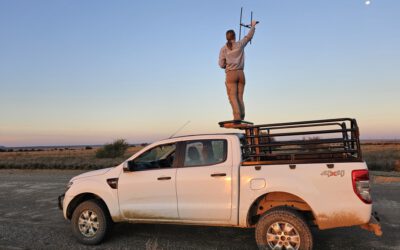
Jolien spent her internship in Kruger National Park in South Africa, working together with SANParks. She was part of an ongoing DFG project here at EORC that looks at how fire and drought shape savanna ecosystems. The project is led by Mirjana Bevanda and Tobias Ullmann, and in the field Jolien teamed up with PhD student Luisa Pflumm.
Her own focus was on how fire and drought affect savanna trees, and on what herbivores add to the picture. Anyone who has watched elephants work over a stand of trees knows that animals are not just background scenery in this system. Fire, drought and grazing all pull on the vegetation at the same time, and pulling them apart is the hard part.
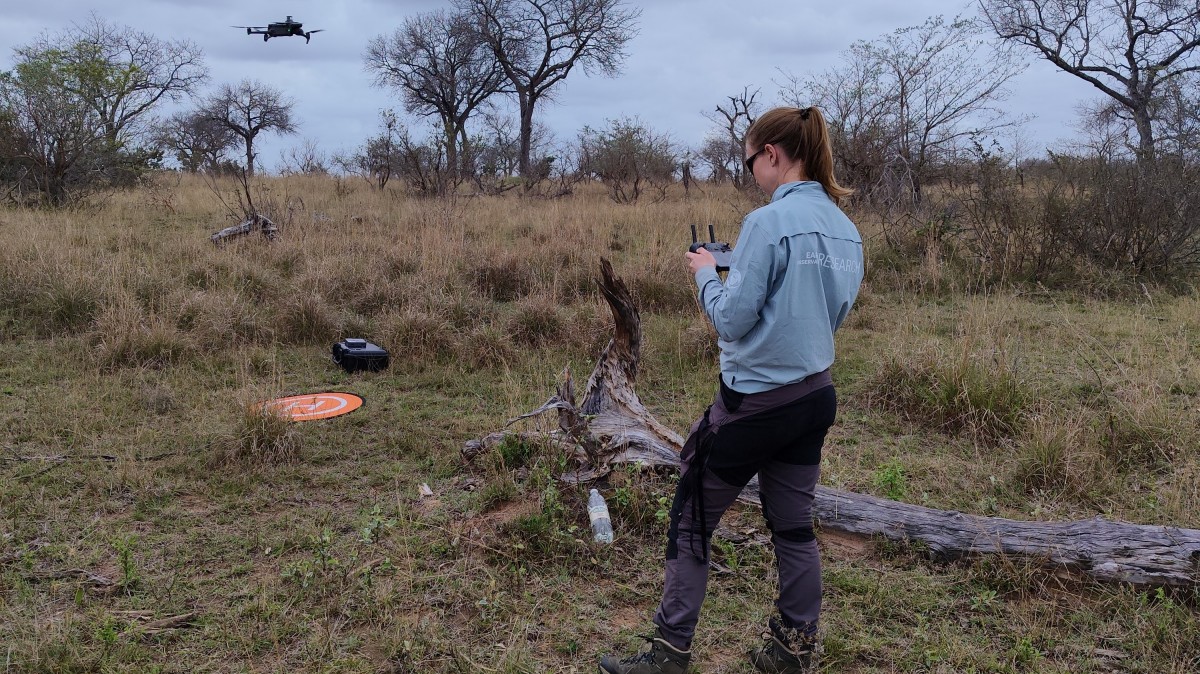
And of course, Jolien did what a young remote sensing scientist does. She collected a lot of data. Her drones carried lidar, thermal and multispectral sensors over the study plots, giving a detailed view of vegetation structure, plant stress and canopy condition from above. But pretty pictures from the sky only get you so far, so she also did the ground work. With very accurate GPS measurements she recorded the position of every single tree in the plots. That sounds tedious, and probably was at times, but it’s what lets you check the drone data against reality tree by tree.
The result is a solid data set that feeds straight back into the project, and a lot of hands-on experience for Jolien in planning fieldwork, flying UAS and analysing what comes back.
Thanks to SANParks for hosting her, to Luisa for the support on site, and to Mirjana and Tobias for making this possible.
Her own focus was on how fire and drought affect savanna trees, and on what herbivores add to the picture. Anyone who has watched elephants work over a stand of trees knows that animals are not just background scenery in this system. Fire, drought and grazing all pull on the vegetation at the same time, and pulling them apart is the hard part.
And of course, Jolien did what a young remote sensing scientist does. She collected a lot of data. Her drones carried lidar, thermal and multispectral sensors over the study plots, giving a detailed view of vegetation structure, plant stress and canopy condition from above. But pretty pictures from the sky only get you so far, so she also did the ground work. With very accurate GPS measurements she recorded the position of every single tree in the plots. That sounds tedious, and probably was at times, but it’s what lets you check the drone data against reality tree by tree.
The result is a solid data set that feeds straight back into the project, and a lot of hands-on experience for Jolien in planning fieldwork, flying UAS and analysing what comes back.
Thanks to SANParks for hosting her, to Luisa for the support on site, and to Mirjana and Tobias for making this possible.
![[Spotlight] Lecturer Spotlight: Julian Faeth](https://eagle-science.org/wp-content/uploads/2026/10/Julian_Faeth_EORC_EAGLE_2026-400x250.jpg)