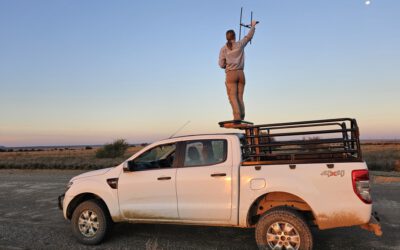
Our EAGLE M.Sc. student Lukas Fronzeck joined Luisa Pflumm, a former EAGLE and now PhD researcher at our Earth Observation Research Cluster (EORC), during fieldwork in Kruger National Park in South Africa. The field campaign forms part of Luisa’s PhD project investigating vegetation dynamics in the savanna ecosystem.
Drone-Based Data Collection in the Savanna
During the campaign, Lukas supported several UAS missions focused on collecting remote sensing data. The team conducted drone flights equipped with multispectral sensors and LiDAR to capture detailed information on vegetation structure and condition.
Operating drones in the savanna landscape in the middle of Kruger National Park provided a unique environment for fieldwork. The data acquisition focused on monitoring vegetation during the wet season, an important period for observing ecosystem recovery after fires.
The long-term monitoring campaign aims to better understand how vegetation responds to combined fire and drought stress, two major drivers shaping savanna ecosystems.
From Drone Data to Vegetation Structure
After data collection, the imagery and LiDAR data are processed to generate detailed spatial products, including:
-
Digital Surface Models (DSMs) representing the elevation of the landscape and vegetation
-
Canopy Height Models (CHMs) describing the height and structure of the vegetation canopy
These datasets help researchers analyze how vegetation regrows and changes following fire events and periods of drought.
Collaboration in a Conservation Landscape
Beyond the technical work, the field campaign also provided opportunities for scientific exchange with researchers and practitioners working in conservation and national park management. Such collaboration is essential for translating remote sensing research into practical applications for ecosystem monitoring and management.
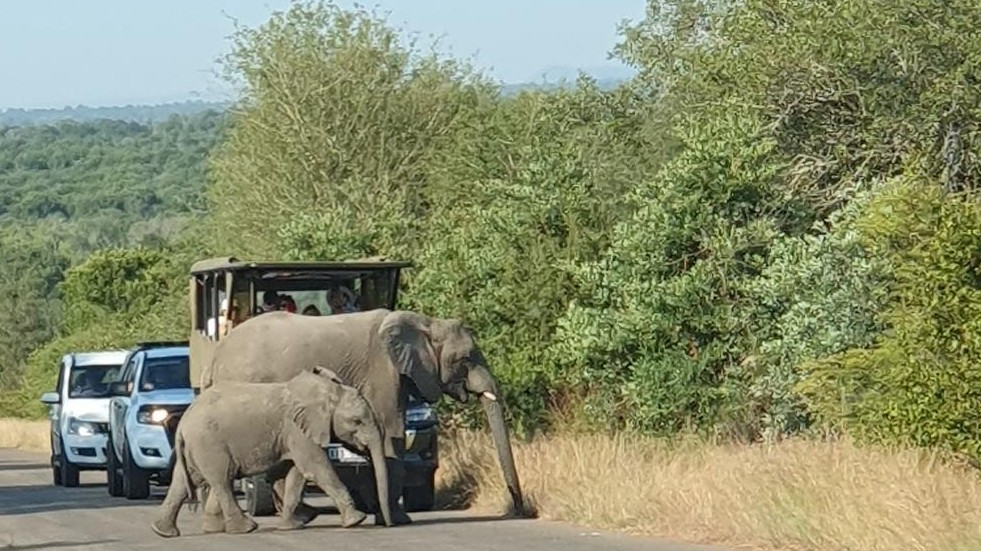
And of course, fieldwork in Kruger National Park also came with an additional highlight: encounters with a wide range of wildlife, making the experience even more memorable.
Next Step: Wildlife and Conservation Work
For the remainder of his internship, Lukas will continue his stay in South Africa by working with state veterinarians and the NGO Contemplate Wild.
During this next phase, he will gain insights into several conservation topics, including:
-
Poaching and anti-poaching efforts
-
Landscape analysis for wildlife management
-
Animal monitoring and conservation practice
The internship thus connects remote sensing research with real-world conservation challenges, offering valuable experience at the interface of earth observation, ecology, and wildlife management.
![[spotlight] Lecturer Spotlight: Thilo Erbertseder](https://eagle-science.org/wp-content/uploads/2026/10/Thilo_Lecturer_Portrait_EAGLE_EORC_2026-400x250.jpg)
![[Spotlight] Lecturer Spotlight: Julian Faeth](https://eagle-science.org/wp-content/uploads/2026/10/Julian_Faeth_EORC_EAGLE_2026-400x250.jpg)