A central goal of the EAGLE Earth Observation programme is to equip students with a broad and practical understanding of the software tools used in geospatial analysis. Rather than focusing on a single platform, students are encouraged to explore different approaches, interfaces, and processing philosophies. This semester, this included hands-on work with a wide range of open-source software, such as GRASS GIS, Orfeo Toolbox (OTB), SAGA GIS, Blender, QGIS, and WhiteboxTools.
Through guided exercises and independent exploration, students learned how these tools complement one another and how they can be combined within flexible workflows. Some software excels at raster-based environmental analysis, others at image processing, terrain modelling, or interactive visualisation. By working across several environments, students gained a better understanding of both the strengths and limitations of individual tools, as well as the importance of choosing appropriate methods for specific research questions.
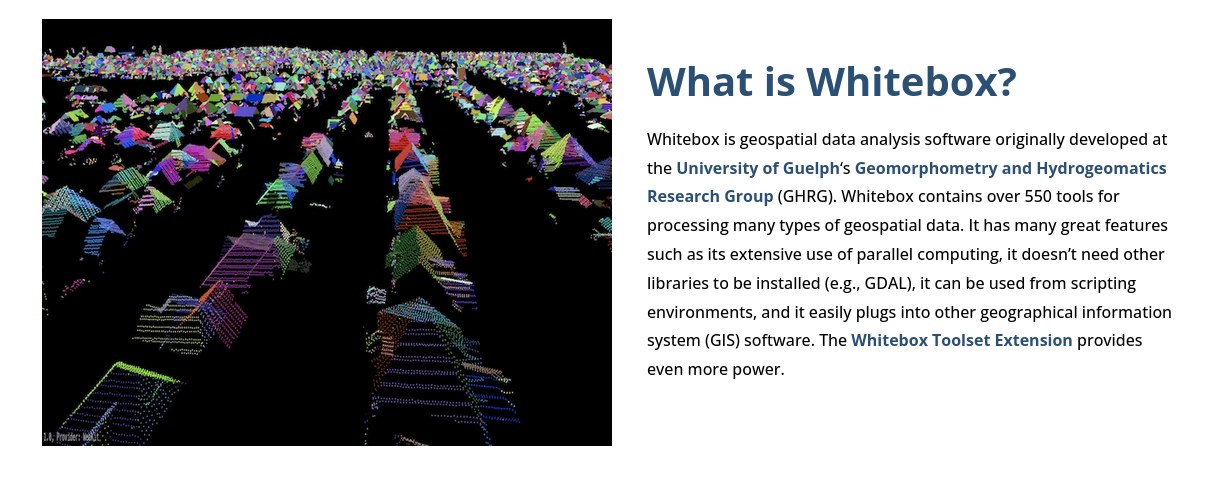
A particular focus was placed on WhiteboxTools, which the EAGLE students explored in more detail. WhiteboxTools is an open-source geospatial analysis library with a strong emphasis on terrain analysis, hydrology, and raster-based spatial modelling. It provides a large collection of algorithms for tasks such as digital elevation model (DEM) processing, flow routing, watershed delineation, geomorphometric analysis, and surface derivatives. These functions are especially relevant for Earth observation applications that rely on elevation data and spatial context.
One of the strengths of WhiteboxTools is its flexible integration into different working environments. Students experimented not only with its standalone functionality, but also with calling WhiteboxTools from R, enabling reproducible and script-based analysis, and from QGIS, where it can be used as part of more visual and interactive workflows. This demonstrated how advanced geospatial processing can be embedded into existing analysis pipelines without leaving familiar environments.
By engaging with this variety of tools, students developed not only technical skills but also a more critical understanding of software design, documentation, and reproducibility. Learning to navigate different interfaces and programming options is an important step toward independent research and professional practice in Earth observation.
Overall, the experience reflects the EAGLE programme’s emphasis on methodological breadth, openness, and practical competence. Exposure to a diverse software ecosystem prepares students to adapt to new tools, collaborate across disciplines, and make informed choices in their future research and applied projects.
![[Spotlight] Lecturer Spotlight: Julian Faeth](https://eagle-science.org/wp-content/uploads/2026/10/Julian_Faeth_EORC_EAGLE_2026-400x250.jpg)