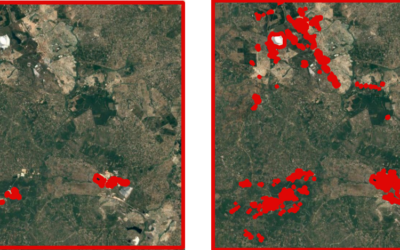
Luisa will defend her M.Sc. thesis “Using remote sensing to enhance conservation decision-making: The case of the little-known silver-backed chevrotain” this Friday at 10am in the meeting room John Skilton 4a.
From her abstract: “Southeast Asia is a biodiverse region with high species richness and endemism, but it also faces high levels of anthropogenic pressure such as habitat degradation and unsustainable hunting. The silver-backed chevrotain was rediscovered in Southeast Vietnam after more than 25 years, but information on the species is limited, and currently it has no valid conservation status.
To address knowledge gaps and support conservation efforts, fragmentary data on the species’ preferences and occurrence was compiled from recent camera-trapping studies in Southern Vietnam. Occupancy analysis was conducted to examine species-habitat associations and predict its occurrence probability across potential range. Remote sensing was used to to create the environmental describing covariates.
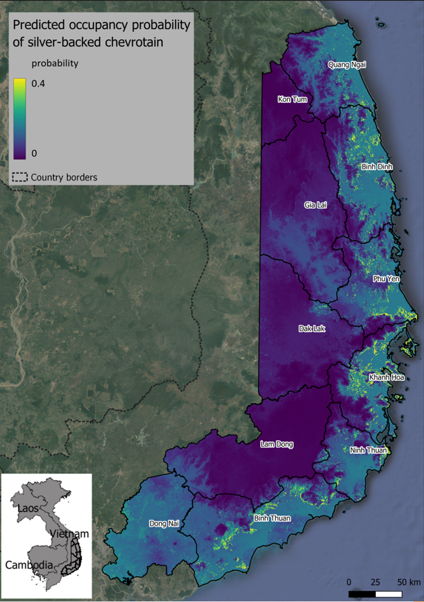
The study found that the silver-backed chevrotain prefers semi-dry forests at low altitudes. It was detected in three sites, Nui Chua national park, Hon Heo pensinsula, and Krong Trai nature reserve. Based on the species-environment relationships, the distribution was predicted across the entire study region, and 22 high priority areas were identified that have the potential to harbour so far undetected silver-backed chevrotain populations. The author suggests focusing future ground searches in Khanh Hoa province due to favorable climatic conditions.
The study provides valuable insights into the ecology of the silver-backed chevrotain and forms the first comprehensive occupancy assessment. It demonstrates the usefulness of remote sensing for species conservation. The study is intended to guide the search for new populations and contribute to a proper Red List assessment to obtain a valid conservation status. Further investigations on species-environment relationships and long-term dynamics are essential for conservation planning. “
done in collaboration with the Leibniz Institute for Zoo- and Wildlife Research.
1. Supervisor: Dr. Insa Otte
2. Supervisor: Dr. Jürgen Niedballa