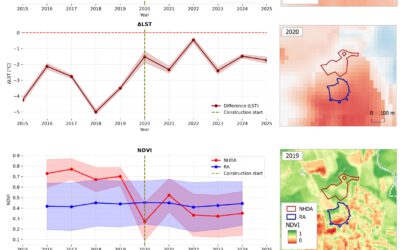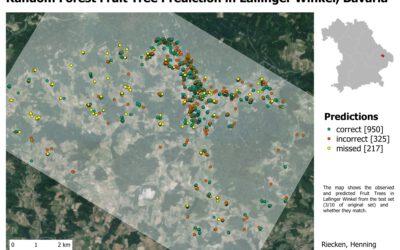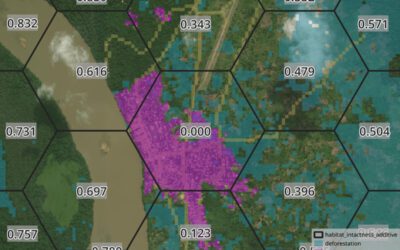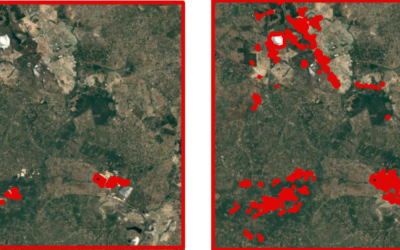
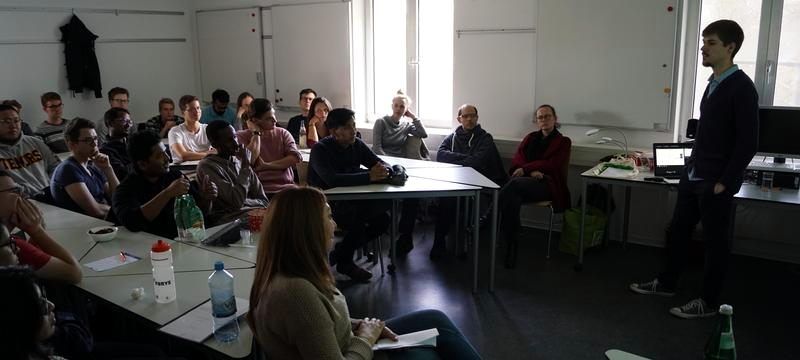
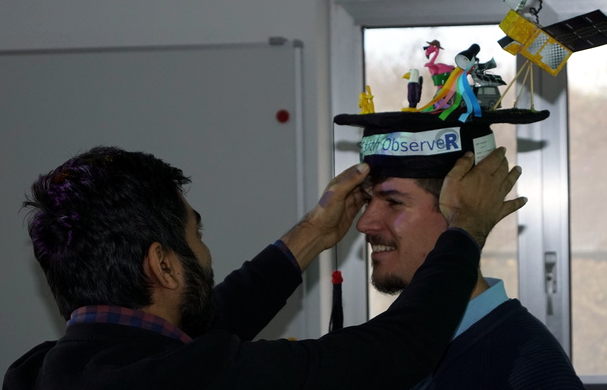
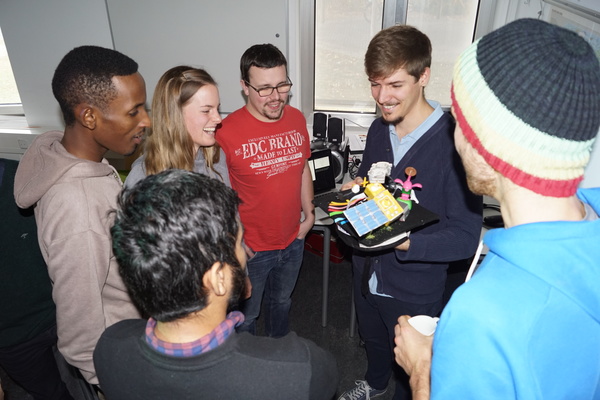
Congratulation to Jakob Schwalb-Willmann who successfully graduated today! His M.Sc. topic was “A deep learning movement prediction framework for identifying anomalies in animal-environment interactions” aiming to explore the potential of animal movement analysis for informing remote sensing data analysis.
The M.Sc. was conducted in collaboration with the Max-Planck-Institute of Ornithology and supervised by Martin Wegmann and Kamran Safi.
From the abstract: “The environmental conditions that animals are exposed to infuence their movement throughout the landscape. A variety of modeling approaches aim to quantify the relationships between animal movement trajectories and environmental variables, e.g. acquired through satellite remote sensing. However, many of such approaches are designed for species-specifc movement modeling and often rely on a priori assumptions, knowledge-based parameterization or the selection of features. In this study, the use of representation learning for predicting animal-environment interactions in a non-parametric, species-independent framework is investigated to enable the unsupervised detection of anomalies. It is shown that a Long Short-Term Memory (LSTM) network is capable of learning generalized representations of the interactions between location and raw environmental features in movement sequences which had been simulated under an agent-based resource selection regime unknown to the network. Thus, the network is able to reconstruct such movement sequences that show similar feature interaction characteristics to the ones the network had learned. On the contrary, the reconstruction of sequences containing patterns that are novel to the network results in a reconstruction error response that was utilized to detect anomalies in movement sequences. It is discussed, how the proposed framework may be applicable for the analysis of animal movement, e.g. for outlier detection, behavioral segmentation or movement simulation. In addition, its potential for supporting environmental research on an inter-species scale, e.g. by detecting phenological indicators from animal movement, is examined.

![[Spotlight] Lecturer Spotlight: Julian Faeth](https://eagle-science.org/wp-content/uploads/2026/10/Julian_Faeth_EORC_EAGLE_2026-400x250.jpg)