Marius Witt will present his M.Sc. thesis “Investigating discharge dynamics at catchment level using
remote sensing timeseries” on Friday 14th of January 2022 at 9am. From the abstract:
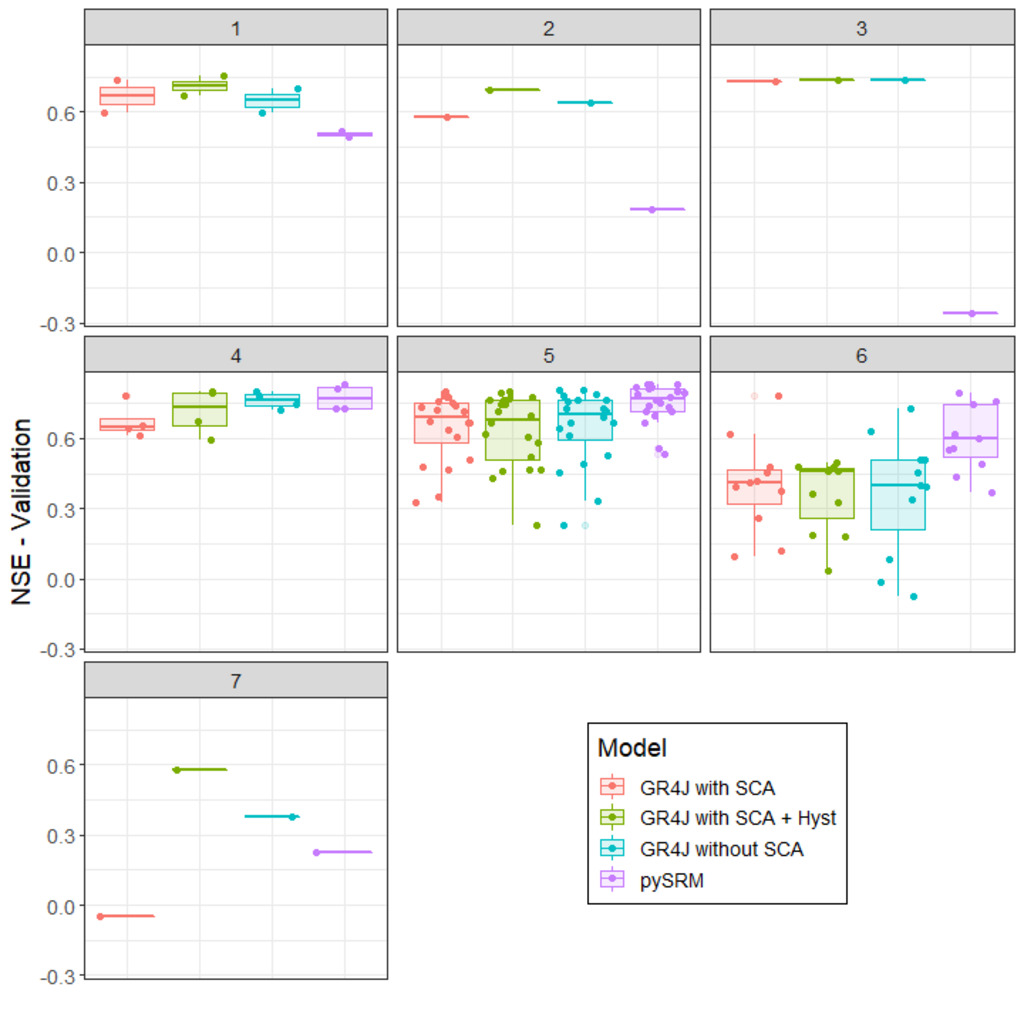
The anthropogenic induced climate change is one of the foremost challenges of the 21st century, with wide ranging consequences on environmental systems. The hydrological cycle, especially in cold regions, is going to be influenced with expected changes in timing and magnitude of snowmelt and floods. Thus, it is important to assess the impact of climate change on the hydrological response of snow dominated catchments, which could be achieved by reliable hydrological models, ideally with little data requirements. The aim of this study is to assess the applicability of simple hydrological models on snow dominated catchments when using climate reanalysis and remote sensing snow cover data. Two conceptual models (SRM and GR4J) were tested for 40 catchments with seven types of natural runoff regimes in five European countries between 2000 and 2020. As input data, a novel climate reanalysis product (ERA-5 Land) and DLR’s Global SnowPack snow cover product were used. To test for possible trends in the environmental parameters, the nonparametric Mann-Kenndal trend test was employed. To assess the interdependency of parameters, pairwise Pearson correlations were calculated. Only a small number of significant trends in temperature, precipitation and snow cover were found. The median Pearson correlations for each type of hydrological regime did show no conclusive patterns. SRM did outperform GR4J in snow dominated catchments with a simple regime. However, the results achieved with a time-invariant parameterization are worse than results for time dependent parameterizations described in literature. This leads to the conclusion, that the conceptual models with time-invariant parameterization assessed in this study are limited in their applicability for climate impact studies, with further need for improvements. Possible improvements discussed are the use of time dependent parameterizations, longer timeseries of environmental data or the use of higher resolution remote sensing snow cover products.
supervisors: Dr. Tobias Ullmann and Dr. Sebastian Rößler (DLR)
![[spotlight] Lecturer Spotlight: Thilo Erbertseder](https://eagle-science.org/wp-content/uploads/2026/10/Thilo_Lecturer_Portrait_EAGLE_EORC_2026-400x250.jpg)

![[Spotlight] Lecturer Spotlight: Julian Faeth](https://eagle-science.org/wp-content/uploads/2026/10/Julian_Faeth_EORC_EAGLE_2026-400x250.jpg)