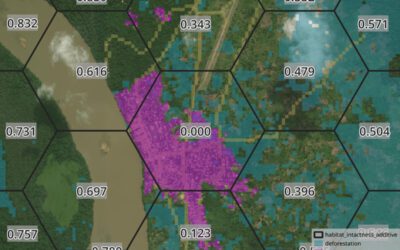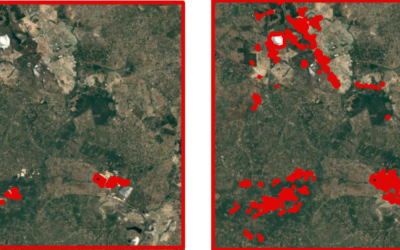
On Friday 11th of February at 9am Camilo Zamora will present his M.Sc. thesis “Deforestation dynamics in the Dry Chaco ecoregion: a three decades of change detection and fragmentation study analysis”. From the abtract: “Tropical forests represent 52% of global forests biomes over the world. Despite their ecological and social significance, these habitats are under unprecedented pressure from a variety of factors, including deforestation, widespread forest degradation and fragmentation. The Gran Chaco ecoregion, a biodiversity hotspot extending through Argentina, Bolivia, and Paraguay, experience the highest global deforestation rate with an annual forest loss of 459 km2/year, and constitutes the second most threatened ecoregion in South America only after the Amazon Forest. The detection of forest change and forest disturbances are a key component to guide actions towards sustainable forest management. Thus, reliable maps of forest cover change have become increasingly important. This study conducted a comprehensive assessment of the forest cover change in the entire Chaco region in Paraguay from 1985 to 2020, at regional and local level. High-resolution Landsat imagery was used to make an Spectral Mixture Analysis (SMA) to calculate the Normalized Difference Fraction Index (NDFI), and consequently apply a decision tree classification. The results revealed that The Chaco region experienced an alarming rate of forest loss, especially during the period 2000-2003. Between 1985 and 1987 forest cover was 76.7%, it decreased to 74.4% for the period 2000 and 2002. After this period, until 2020 the decrease of forest cover dropped until 51.2%. The rapid forest loss was driven by socio-economic forces, including land tenure and land grabbing, forest product exploitation, and industrial agriculture The results also revealed that the established protected areas were effective in protecting forest within their borders. However Analysis of forest change in areas surrounding the PAs revealed that the protected areas did not slow down the forest loss in their surrounding areas. The average forest cover change in the subjacent areas of 5km and 10km from the boundary, where higher than within PAs, with 27% and 29% respectively. The alarming deforestation rates after the year 2000 and the low percentage of forest left in The Chaco region in Paraguay, but also in Argentina and Bolivia call for immediate actions to halt further forest loss.”

supervised by Emmanuel daPonte (DLR) and Martin Wegmann
![[Spotlight] Lecturer Spotlight: Julian Faeth](https://eagle-science.org/wp-content/uploads/2026/10/Julian_Faeth_EORC_EAGLE_2026-400x250.jpg)