Johannes Mast will present his thesis “Analyzing the relationship between urban morphology and economic subcenters with a focus on urban polycentricity using remote sensing and socioeconomic data” on Monday 14th of June at 9am. From the abstract:
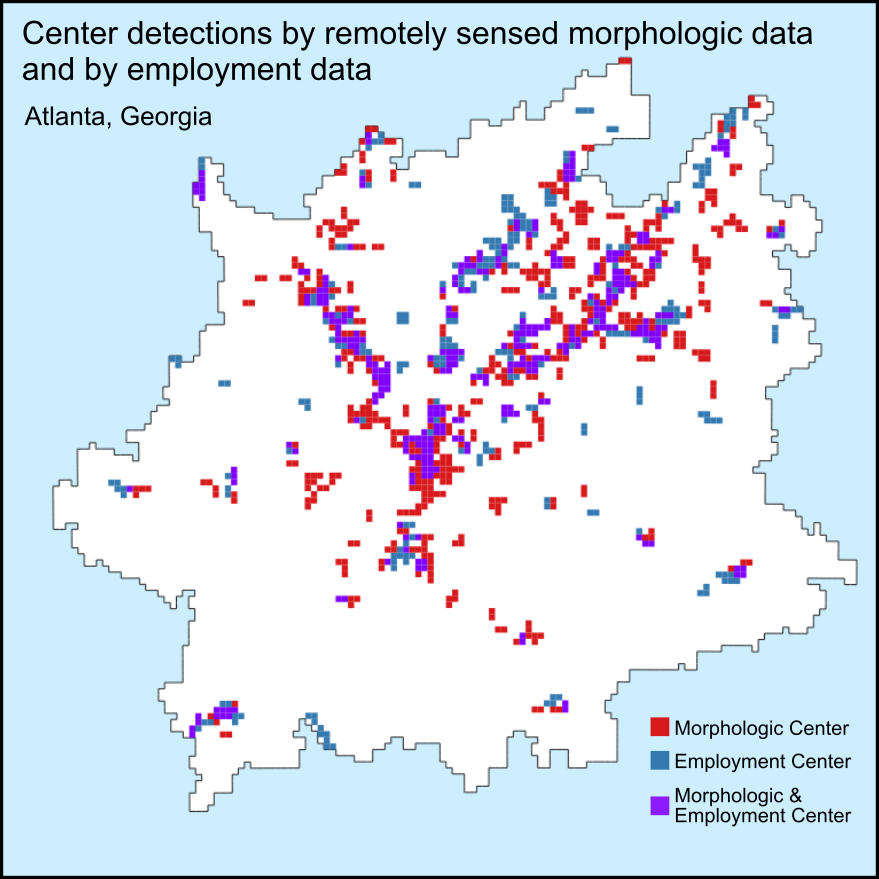
“Polycentricity refers to the existence of more than one center in urban conurbations. While it is a fuzzy concept with no clear definition, it is often approached from a socio-economic perspective using information on the spatial distribution of jobs derived from employment data (EMP). The heterogeneity and shortage of such EMP data is a challenge to the study of polycentricity. Remote sensing of urban morphology could provide a globally available surrogate in the form of TanDEM-X-derived urban mass concentrations (UMC). However, the extent to which UMC are suited to substitute EMP has not yet been systematically analyzed.
To fill this gap, I detect and compare UMC-centers and EMP-centers in four city regions in the United States. I consider the EMP-based centers as a baseline and analyse the degree to which the UMC-centers are congruent with them. In a threefold analysis I quantify the general agreement between UMC and EMP-centers (1), identify morphological patterns and causes of disagreement (2), and assess the feasibility of calculating various measures of polycentricity using UMC data (3). I find that the UMC approach is able to detect major EMP-centers, although with disagreements that often take the form of spatial overestimations. (1) Agreement is much better in economic (number of jobs) than in spatial (area) terms. (2) The mismatches between UMC- and EMP-centers can in many cases be plausibly explained by a nonlinear relationship between employment density and building volume. (3) Employment-based measures of polycentricity show fair agreement, but most spatial measures suffer from estimations errors. Altogether, the vast majority of job concentrations is detected by UMC, but precise anal-yses of distributions are hindered by spatial disagreement. Hence, the results support the careful use of UMC as a substitute for EMP in certain analyses of polycentricity.“
supervisors Hannes Taubenböck and Martin Wegmann



![[Spotlight] Lecturer Spotlight: Julian Faeth](https://eagle-science.org/wp-content/uploads/2026/10/Julian_Faeth_EORC_EAGLE_2026-400x250.jpg)