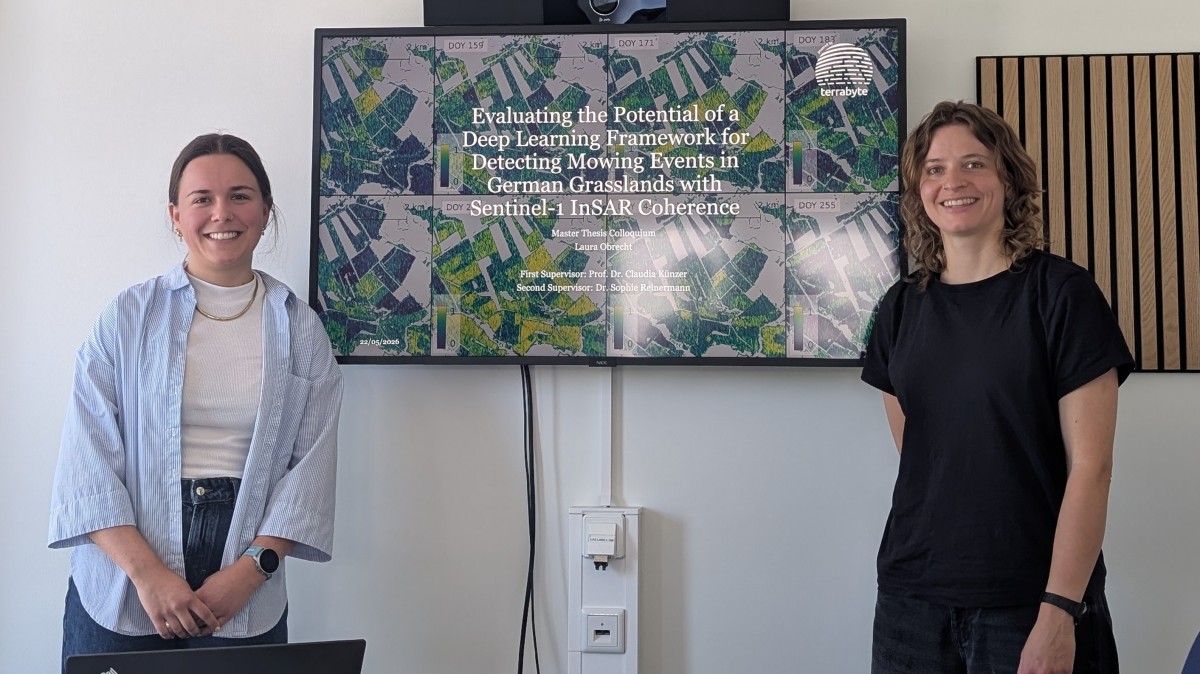
At the recent EAGLE MSc defenses, Laura Obrecht presented her thesis on the detection of grassland mowing events using Sentinel-1 InSAR coherence and deep learning approaches.
Her work, titled “Detektion von Grünlandmahd mit Sentinel-1 InSAR Coherence und einem Deep Learning Framework”, explored the potential of combining interferometric SAR coherence information with modern machine learning methods for large-scale grassland monitoring in Germany.
Using 6-day Sentinel-1 time series from 2019, Laura processed interferometric coherence products that were subsequently downscaled to Sentinel-2 spatial resolution. The processing workflow was implemented on the Terrabyte platform and resulted in more than 3 TB of intermediate and final datasets, highlighting the computational challenges associated with dense SAR time series analysis.
Previous studies have demonstrated the suitability of Sentinel-1 coherence for detecting mowing events on grasslands, especially due to the sensitivity of coherence to abrupt vegetation changes. Building upon this foundation, Laura investigated whether a deep learning framework could improve detection performance at larger scales.
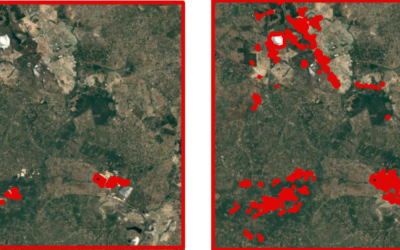
The results showed that the Sentinel-1 InSAR coherence approach detected more mowing events than the currently existing Sentinel-2 VIS-based mowing product. However, the increased sensitivity also resulted in a larger number of false positives. One of the most promising findings of the thesis was therefore the complementarity of both approaches: combining Sentinel-1 coherence information with Sentinel-2 optical products appears to significantly improve the overall detection potential.
The work demonstrates again how our EAGLE MSc. students push Earth Observation science forward!

![[Spotlight] Lecturer Spotlight: Julian Faeth](https://eagle-science.org/wp-content/uploads/2026/10/Julian_Faeth_EORC_EAGLE_2026-400x250.jpg)