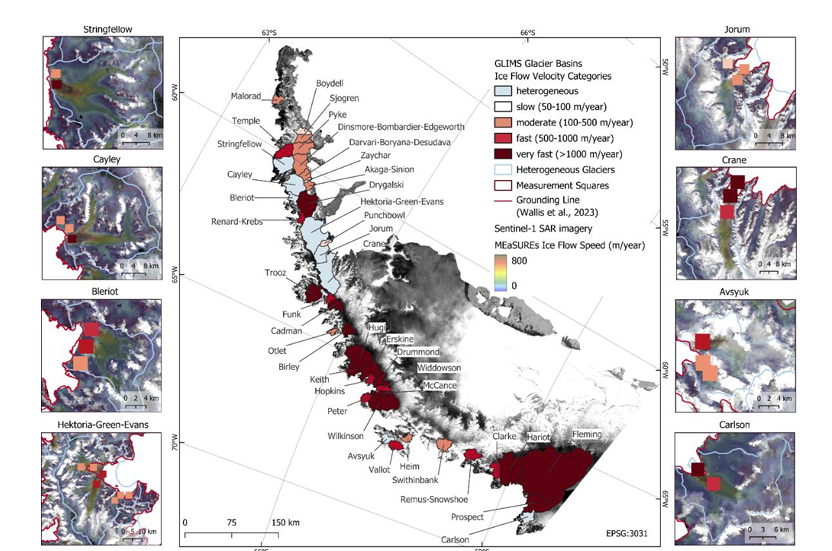
On February 28, 2025, Sarah Leibrock will present her internship on “High Performance Computing for Earth Observation Time Series Analysis: A Case Study on Glacier Dynamics on the Antarctic Peninsula” at 11:00 in seminar room 3, John-Skilton-Str. 4a.High Performance Computing for Earth Observation Time Series Analysis: A Case Study on Glacier Dynamics on the Antarctic Peninsula
From the abstract:
High-performance computing (HPC) has become indispensable in the field of Earth observation (EO), where advancements in sensor technology have resulted in a continuous influx of high dimensional, spectral and spatial time-series data. In cryospheric research, remote sensing is an essential tool for monitoring the dynamics of glaciers in Antarctica due to their remote and often inaccessible nature. Large volumes of data are generated from extensive satellite observation time series, offering detailed insights into various aspects of glacier behavior. The complexity and scale of these datasets make HPC an ideal tool for analysis, as it can handle the intensive computational demands required to process and interpret such vast information efficiently. Consequently, glacier dynamics serve as a compelling case study for demonstrating the potential of HPC for large-scale EO time series data analysis, especially in regions like the Antarctic Peninsula (AP), where understanding glacier behavior is crucial for assessing climate change impacts. This thesis leveraged the potential of HPC resources to process and analyse extensive remote sensing datasets, providing new insights into recent dynamics of 42 key outlet glaciers on the AP from 2013 to 2024, contributing to a deeper understanding of how these glaciers behave and respond to external factors. The results demonstrated the potential of HPC for enhancing the processing and analysis of large EO time series data by enabling seamless data integration, efficient computational workflows, and optimized resource management. The case study revealed ongoing trends of glacier retreat and acceleration for nearly all glaciers with more dramatic changes occurring on the eastern side of the AP. There, distinct glacier dynamics between the Larsen A and Larsen B embayments were identified, driven by differences in landfast sea ice persistence, bathymetric conditions, and oceanic influences.
1st supervisor: Dr. Celia Baumhoer
2nd supervisor: Prof. Dr. Tobias Ullmann
![[spotlight] Lecturer Spotlight: Martin Wegmann](https://eagle-science.org/wp-content/uploads/2026/07/Martin_Wegmann_EAGLE_lecture_2026-400x250.jpg)