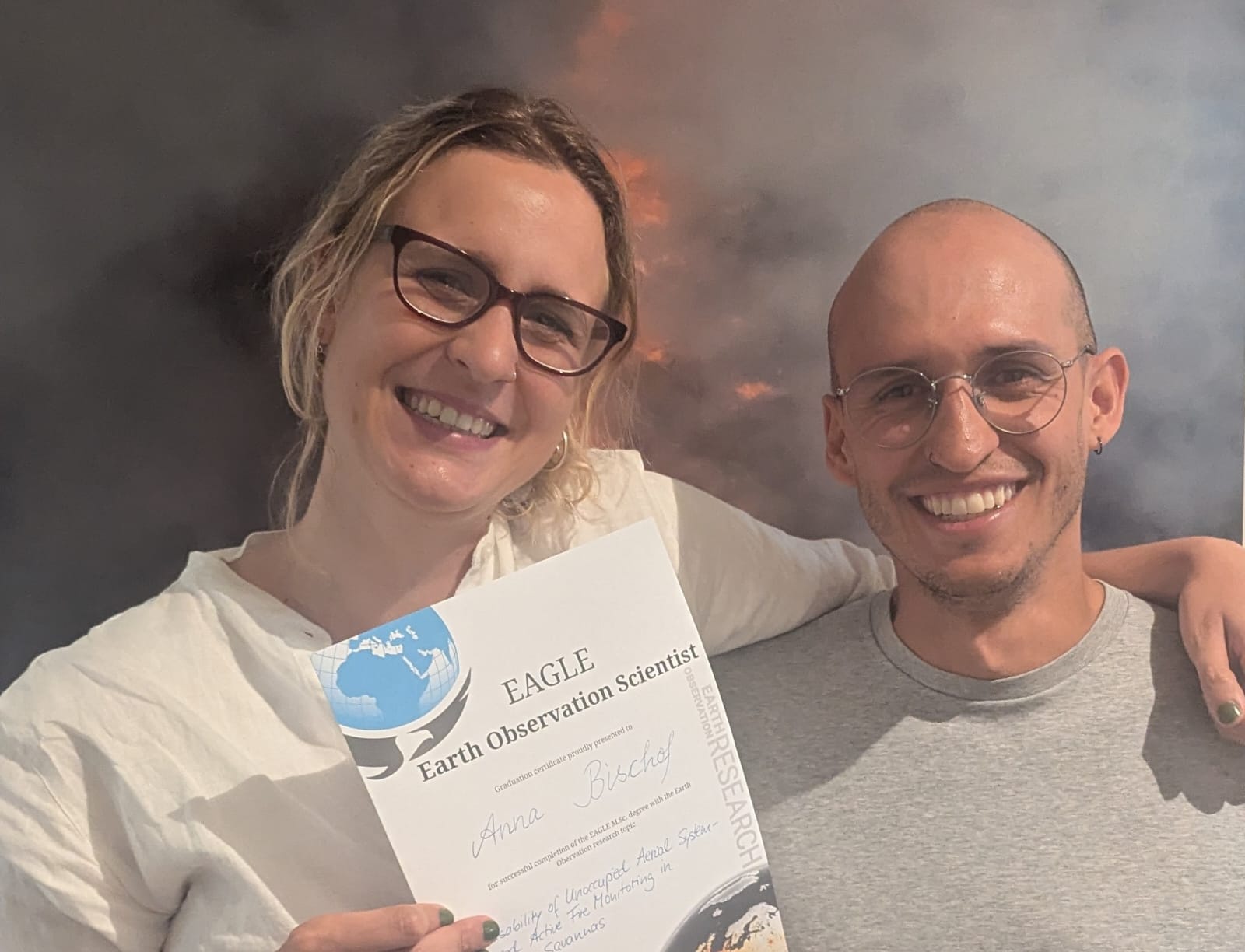
We congratulate Anna Bischof on the successful defense of her MSc thesis, “Feasibility of Unoccupied Aerial System-Based Active Fire Monitoring in African Savannas.”
Anna’s research addressed one of the key challenges in fire ecology and remote sensing: understanding fire dynamics at spatial and temporal scales that cannot be adequately captured by satellite observations. While satellite-based active fire products are indispensable for large-scale monitoring, they often miss the fine-scale processes that determine how fires spread through heterogeneous savanna landscapes.
To tackle this challenge, Anna developed and evaluated a novel framework for active fire monitoring using multiple unoccupied aerial systems (UAS). Her work was based on an intensive field campaign conducted during a prescribed burn in Kruger National Park, South Africa, where three thermal UAS platforms simultaneously monitored fire behaviour across a six-hectare study area. More than 10,000 thermal images were collected during an 87-minute observation period, providing an unprecedented dataset of active fire dynamics.
A major contribution of the thesis was the development of an acquisition-aware orthorectification workflow capable of transforming oblique thermal imagery into georeferenced products without requiring ground control points. Using these data, Anna reconstructed fire progression through time and generated detailed time-to-burn maps that revealed multiple advancing fire fronts and distinct phases of fire development. Her analysis demonstrated that oblique and nadir viewing geometries provide complementary information, highlighting the advantages of coordinated multi-platform UAS observations for fire monitoring in complex savanna environments.
The work builds upon broader research activities within the Earth Observation Research Cluster focused on understanding fire and drought interactions in African savannas. Anna contributed to field campaigns involving thermal remote sensing, LiDAR, and multispectral observations, helping to advance methodologies for monitoring ecosystem responses to fire and environmental change.
Following the completion of her MSc, Anna has joined the European Commission Joint Research Centre (EU-JRC), where she continues to apply her expertise in Earth observation and environmental monitoring. Later this year, she will begin a new position with the Food and Agriculture Organization of the United Nations in Cairo, contributing to international efforts in environmental monitoring and sustainable land management.
Anna’s academic journey reflects the strong connection between cutting-edge research, international fieldwork, and real-world applications of Earth observation science. We congratulate her on this important achievement and wish her every success in her future work with both the EU-JRC and FAO.
The thesis was supervised by Antonio José Castañeda-Gómez and Dr. Mirjana Bevanda.
Anna’s research addressed one of the key challenges in fire ecology and remote sensing: understanding fire dynamics at spatial and temporal scales that cannot be adequately captured by satellite observations. While satellite-based active fire products are indispensable for large-scale monitoring, they often miss the fine-scale processes that determine how fires spread through heterogeneous savanna landscapes.
To tackle this challenge, Anna developed and evaluated a novel framework for active fire monitoring using multiple unoccupied aerial systems (UAS). Her work was based on an intensive field campaign conducted during a prescribed burn in Kruger National Park, South Africa, where three thermal UAS platforms simultaneously monitored fire behaviour across a six-hectare study area. More than 10,000 thermal images were collected during an 87-minute observation period, providing an unprecedented dataset of active fire dynamics.
A major contribution of the thesis was the development of an acquisition-aware orthorectification workflow capable of transforming oblique thermal imagery into georeferenced products without requiring ground control points. Using these data, Anna reconstructed fire progression through time and generated detailed time-to-burn maps that revealed multiple advancing fire fronts and distinct phases of fire development. Her analysis demonstrated that oblique and nadir viewing geometries provide complementary information, highlighting the advantages of coordinated multi-platform UAS observations for fire monitoring in complex savanna environments.
The work builds upon broader research activities within the Earth Observation Research Cluster focused on understanding fire and drought interactions in African savannas. Anna contributed to field campaigns involving thermal remote sensing, LiDAR, and multispectral observations, helping to advance methodologies for monitoring ecosystem responses to fire and environmental change.
Following the completion of her MSc, Anna has joined the European Commission Joint Research Centre (EU-JRC), where she continues to apply her expertise in Earth observation and environmental monitoring. Later this year, she will begin a new position with the Food and Agriculture Organization of the United Nations in Cairo, contributing to international efforts in environmental monitoring and sustainable land management.
Anna’s academic journey reflects the strong connection between cutting-edge research, international fieldwork, and real-world applications of Earth observation science. We congratulate her on this important achievement and wish her every success in her future work with both the EU-JRC and FAO.
The thesis was supervised by Antonio José Castañeda-Gómez and Dr. Mirjana Bevanda.
![[spotlight] Lecturer Spotlight: Martin Wegmann](https://eagle-science.org/wp-content/uploads/2026/07/Martin_Wegmann_EAGLE_lecture_2026-400x250.jpg)