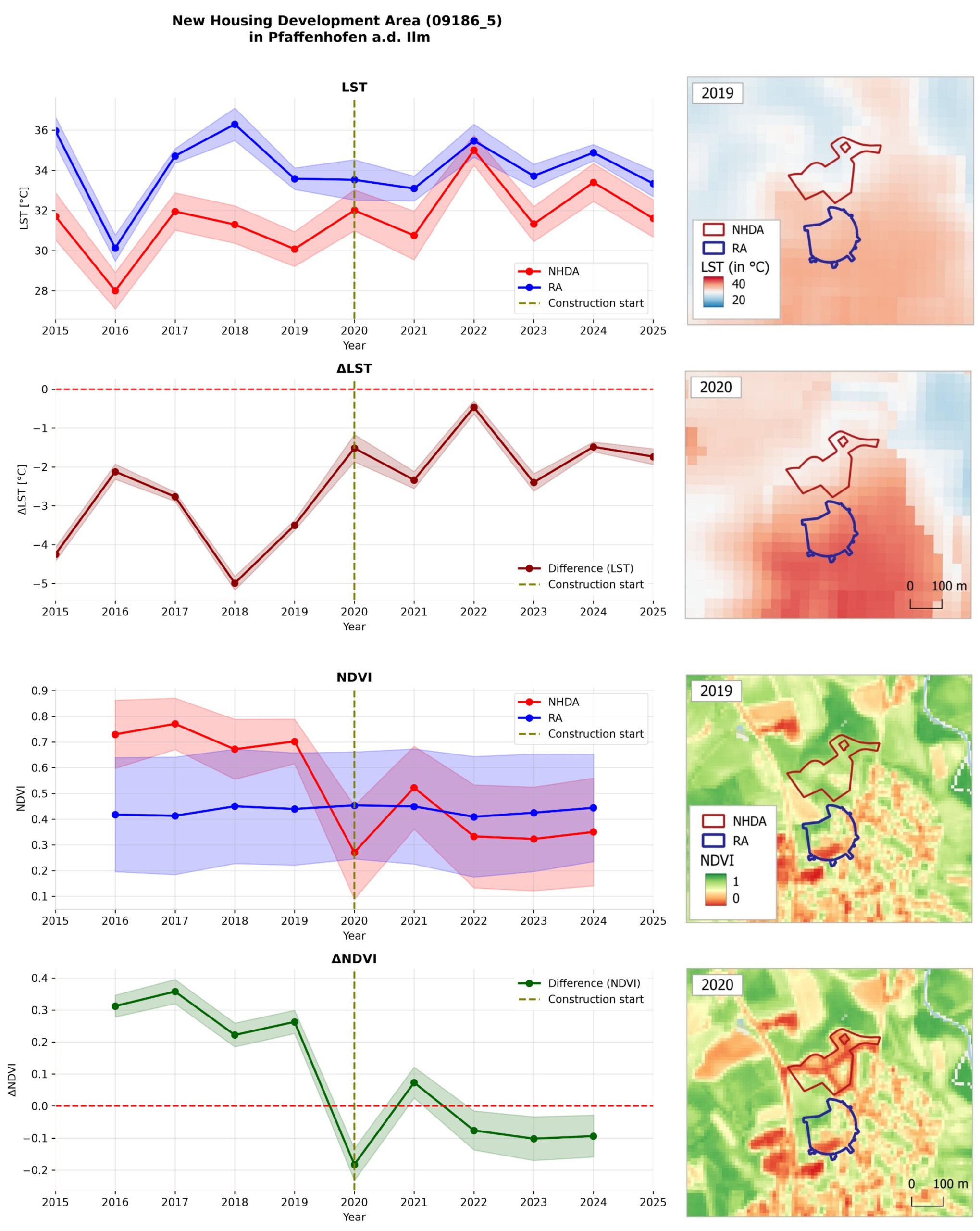
On September 22, 2026, Agnes Zwick will present her Master Thesis on ” New Housing Development Areas: Assessing Structural Types and Environmental Effect” at 10:00 at the seminar room 3 in John-Skilton-Str. 4a.
From the abstract: Germany faces a persistent tension between accelerating housing construction and meeting its land-saving and climate-adaptation objectives. While official statistics document construction activity at the level of individual buildings, no publicly available dataset captures the location, spatial extent, or environmental performance of coherent new housing development areas (NHDAs). This thesis addresses this gap by developing and applying a spatially explicit, reproducible workflow to identify, characterise, and environmentally evaluate NHDAs across Bavaria over the period 2015–2024/25.
Newly constructed residential buildings were identified from changes in publicly available and regularly updated three-dimensional building models. These buildings were aggregated into spatially coherent NHDAs and characterized by urban morphology and dominant residential building type. Construction start years were estimated with a random forest (RF) classifier trained on multi-year Sentinel-2 Normalized Difference Vegetation Index (NDVI) time series. A spatially corresponding reference area (RA) was defined for each NHDA within the existing urban fabric to separate development-related environmental change from background variability. Both NHDAs and RAs were characterized by urban morphology, contextual variables, and environmental conditions, represented by Land Surface Temperature (LST) and NDVI. Gaussian linear mixed-effects models quantified the relationship between morphological differences and environmental outcomes. An exploratory structural causal model complemented this analysis by examining potential pathway-specific associations.
Across the 839 identified NHDAs, new developments are predominantly built on agricultural land and are less densely built and populated than their RAs, accommodating on average 36% fewer residents per hectare.
1st supervisor: Dr. John Friesen
2nd (external) supervisor: Prof. Dr. Hannes Taubenböck
From the abstract: Germany faces a persistent tension between accelerating housing construction and meeting its land-saving and climate-adaptation objectives. While official statistics document construction activity at the level of individual buildings, no publicly available dataset captures the location, spatial extent, or environmental performance of coherent new housing development areas (NHDAs). This thesis addresses this gap by developing and applying a spatially explicit, reproducible workflow to identify, characterise, and environmentally evaluate NHDAs across Bavaria over the period 2015–2024/25.
Newly constructed residential buildings were identified from changes in publicly available and regularly updated three-dimensional building models. These buildings were aggregated into spatially coherent NHDAs and characterized by urban morphology and dominant residential building type. Construction start years were estimated with a random forest (RF) classifier trained on multi-year Sentinel-2 Normalized Difference Vegetation Index (NDVI) time series. A spatially corresponding reference area (RA) was defined for each NHDA within the existing urban fabric to separate development-related environmental change from background variability. Both NHDAs and RAs were characterized by urban morphology, contextual variables, and environmental conditions, represented by Land Surface Temperature (LST) and NDVI. Gaussian linear mixed-effects models quantified the relationship between morphological differences and environmental outcomes. An exploratory structural causal model complemented this analysis by examining potential pathway-specific associations.
Across the 839 identified NHDAs, new developments are predominantly built on agricultural land and are less densely built and populated than their RAs, accommodating on average 36% fewer residents per hectare.
1st supervisor: Dr. John Friesen
2nd (external) supervisor: Prof. Dr. Hannes Taubenböck

![[Spotlight] Lecturer Spotlight: Julian Faeth](https://eagle-science.org/wp-content/uploads/2026/10/Julian_Faeth_EORC_EAGLE_2026-400x250.jpg)