On May 22, 2026, Laura Obrecht will present her Master Thesis on ” Evaluating the Potential of a Deep Learning Framework for Detecting Mowing Events in German Grasslands with Sentinel-1 InSAR Coherence” at 11:00 a.m. in room 01.B.03 (EORC meeting room 1st floor).
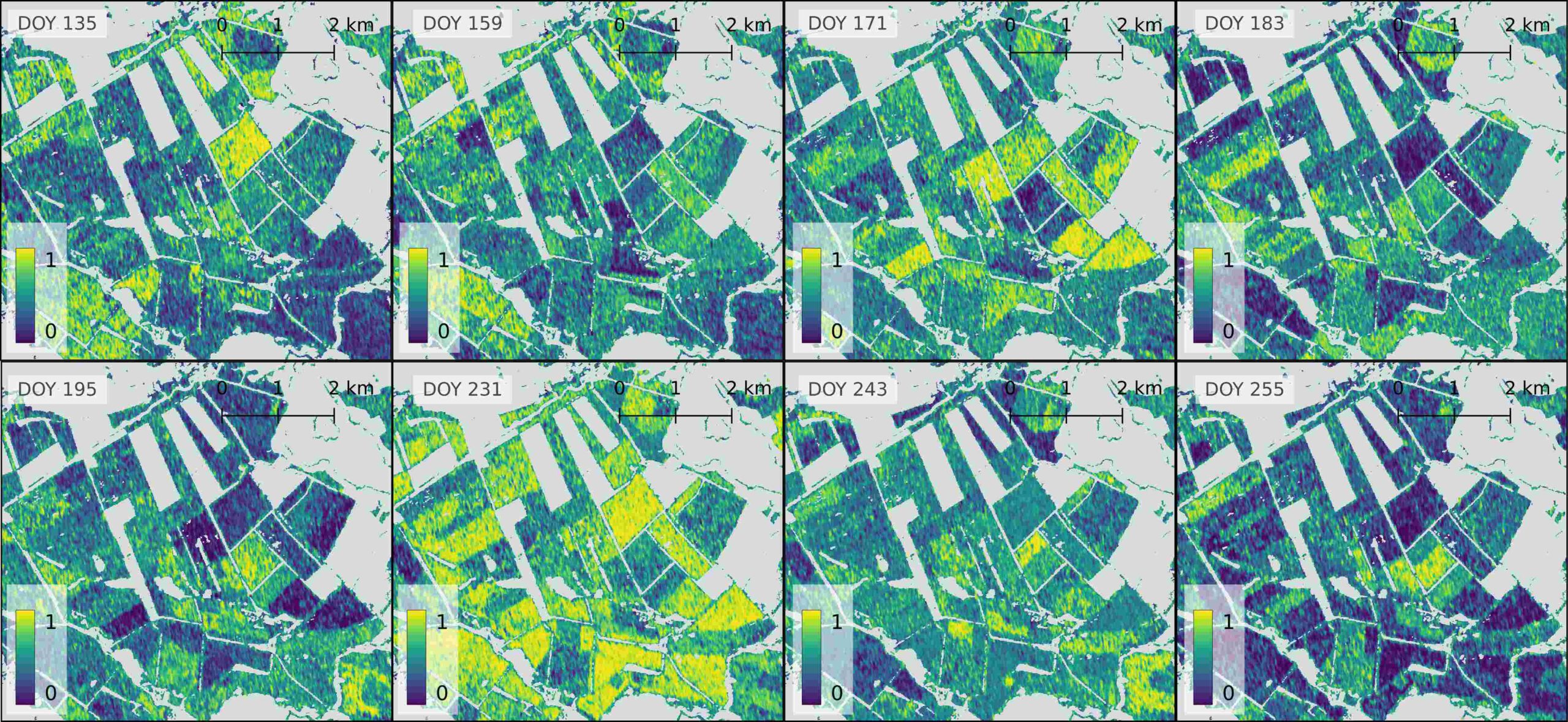
From the abstract: Monitoring grassland management intensity is essential for agricultural monitoring, biodiversity assessment, and policy support. Satellite-based detection of mowing events has primarily relied on optical data, which is limited by cloud cover and illumination conditions. Synthetic Aperture Radar (SAR), and in particular interferometric coherence derived from Sentinel-1, provides a weather-independent alternative that is sensitive to structural changes in vegetation. This study presents the first Germany-wide implementation of a high-temporal resolution (6-day) Sentinel-1 coherence processing pipeline for mowing detection. Building on this dataset, a one-dimensional convolutional neural network (1D-CNN) was trained on coherence time series sequences using weak supervision derived from an existing Sentinel-2-based mowing product. The model was designed to detect mowing events solely from temporal coherence dynamics and evaluated both at pixel level and after aggregation to spatial management units. Results show that coherence is a viable predictor for mowing events, capturing structural changes associated with biomass removal. Spatial aggregation to parcel-like units substantially improves the robustness and interpretability of the results by reducing speckle-related noise and enforcing realistic spatial patterns. The combination of coherence-based predictions with optical vegetation indices yields a more balanced detection product, increasing recall while maintaining acceptable precision. Overall, this study demonstrates that multi-sensor fusion of Sentinel-1 coherence and optical data enables robust, large-scale monitoring of grassland mowing events. The proposed methodology is transferable across regions and years and provides a foundation for operational monitoring of grassland management intensity under varying environmental conditions.
1st supervisor: Prof. Dr. Tobias Ullmann 2nd (external) supervisor: Dr. Sophie Reinermann, DLR
From the abstract: Monitoring grassland management intensity is essential for agricultural monitoring, biodiversity assessment, and policy support. Satellite-based detection of mowing events has primarily relied on optical data, which is limited by cloud cover and illumination conditions. Synthetic Aperture Radar (SAR), and in particular interferometric coherence derived from Sentinel-1, provides a weather-independent alternative that is sensitive to structural changes in vegetation. This study presents the first Germany-wide implementation of a high-temporal resolution (6-day) Sentinel-1 coherence processing pipeline for mowing detection. Building on this dataset, a one-dimensional convolutional neural network (1D-CNN) was trained on coherence time series sequences using weak supervision derived from an existing Sentinel-2-based mowing product. The model was designed to detect mowing events solely from temporal coherence dynamics and evaluated both at pixel level and after aggregation to spatial management units. Results show that coherence is a viable predictor for mowing events, capturing structural changes associated with biomass removal. Spatial aggregation to parcel-like units substantially improves the robustness and interpretability of the results by reducing speckle-related noise and enforcing realistic spatial patterns. The combination of coherence-based predictions with optical vegetation indices yields a more balanced detection product, increasing recall while maintaining acceptable precision. Overall, this study demonstrates that multi-sensor fusion of Sentinel-1 coherence and optical data enables robust, large-scale monitoring of grassland mowing events. The proposed methodology is transferable across regions and years and provides a foundation for operational monitoring of grassland management intensity under varying environmental conditions.
1st supervisor: Prof. Dr. Tobias Ullmann 2nd (external) supervisor: Dr. Sophie Reinermann, DLR
![[Spotlight] Lecturer Spotlight: Julian Faeth](https://eagle-science.org/wp-content/uploads/2026/10/Julian_Faeth_EORC_EAGLE_2026-400x250.jpg)