
Magdalena Halbgewachs will present her MSc thesis “A Spectral Mixture Analysis and Landscape Metrics based framework for monitoring spatio-temporal forest cover changes: A case study in Mato Grosso, Brazil” on Wednesday 16th of June at 9am.
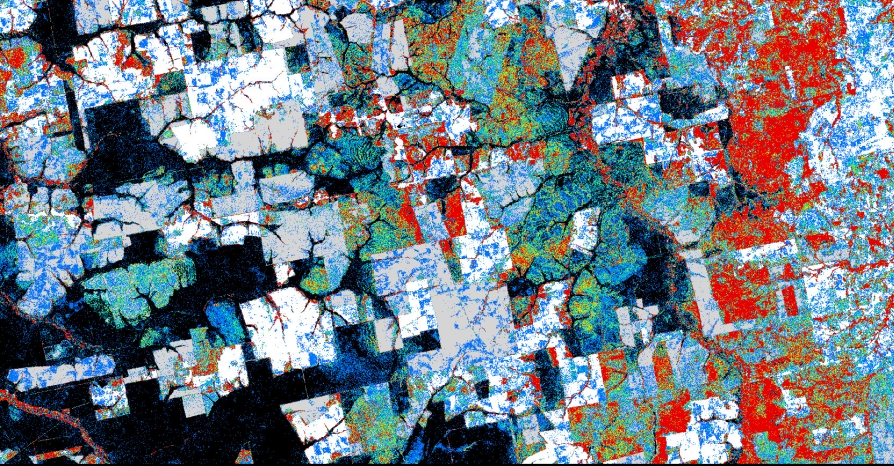
From the abstract: More and more Brazilian rainforest is being lost or degraded for various reasons, both anthropogenic and natural, leading to a loss of biodiversity and further global consequences. Especially in the Brazilian state of Mato Grosso, soy production and large cattle farms have led to large losses of rainforest in recent years. To monitor these losses, in this study, Landsat data were used to create classifications for the years 1986 to 2020 based on a spectral mixture analysis followed by a decision tree classification. The classifications were used to determine land cover changes for each year, focusing on cleared and degraded forest areas. In addition, illegally cleared areas were identified using legally issued logging permits. Both legal and illegal areas were intersected with the state cadastral system to provide information on the distribution of logging in each cadastral class. The analyses showed that the forest area in Mato Grosso has decreased by 28.8% since 1986, and that the proportion of illegally cleared areas is significantly higher than that of legal clear-cuts, averaging 99.5% in the years analyzed. In order to measure changed forest structures for the selected period, fragmentation analyses based on diverse landscape metrics were carried out for three selected municipalities in Mato Grosso. It was found that forest areas in these municipalities become highly fragmented over the years, with more and more individual small forest fragments emerging, resulting in altered habitats for flora and fauna.
supervisors: Martin Wegmann and Emmanuel DaPonte (DLR)