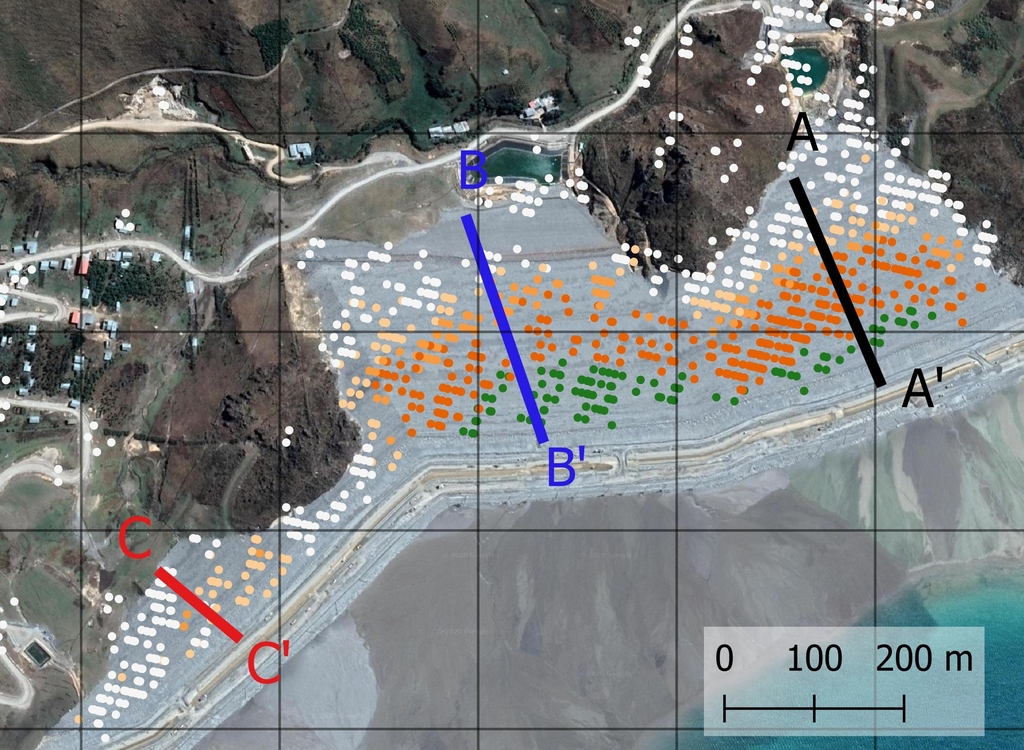
Basil Tufail will present his M.Sc. thesis “Monitoring the Displacement of an Active Tailings Dam in Peru using Persistent Scatterer Interferometry (PS-InSAR)” on Friday, June 18th, at 9am.

From the abstract: “As mining activities and the number of tailings dam grow globally with it also has increased
failures of tailings dams in the previous decades. For this continuous monitoring is required and radar has proven to be a useful source of data. In recent years Synthetic Aperture Radar data has become widely used especially since the availability of open source products like Sentinel-1 A and B. The focus of this research is a case study of monitoring the Cerro Corona facility in the Cajamarca region of Peru, which is an active tailings storage dam. The periodic raising in the dam structure to increase storage is what makes active dams different from inactive closed sites. All possible Sentinel-1 scenes in the descending mode going back to 2014 were used. Applying Differential Synthetic Aperture Radar interferometry (DInSAR) algorithm to evaluate a time series trend to see the natural subsidence in the tailings dam. The methodology is devised to use the specific Persistent Scattering technique which is a form of InSAR to analyse the average velocity change and displacement time series for the CerroCorona. It is harder to find Persistent Scatterers especially when there is human intervention and the crest is raised. The general processing up till the creation of Interferograms will be done in SNAP and the Persistent Scatter part will be done using StaMPS. The results from the study show that a linear trend line is observed for the increase in velocity changes with time whereas average displacement rates in the dam structure show
a high correlation with the height of the tailings deposited.”
supervisors are Tobias Ullmann and Eleanor Ainscoe (Senior Earth Observation Scientist at HR Wallingford)

![[Spotlight] Lecturer Spotlight: Julian Faeth](https://eagle-science.org/wp-content/uploads/2026/10/Julian_Faeth_EORC_EAGLE_2026-400x250.jpg)