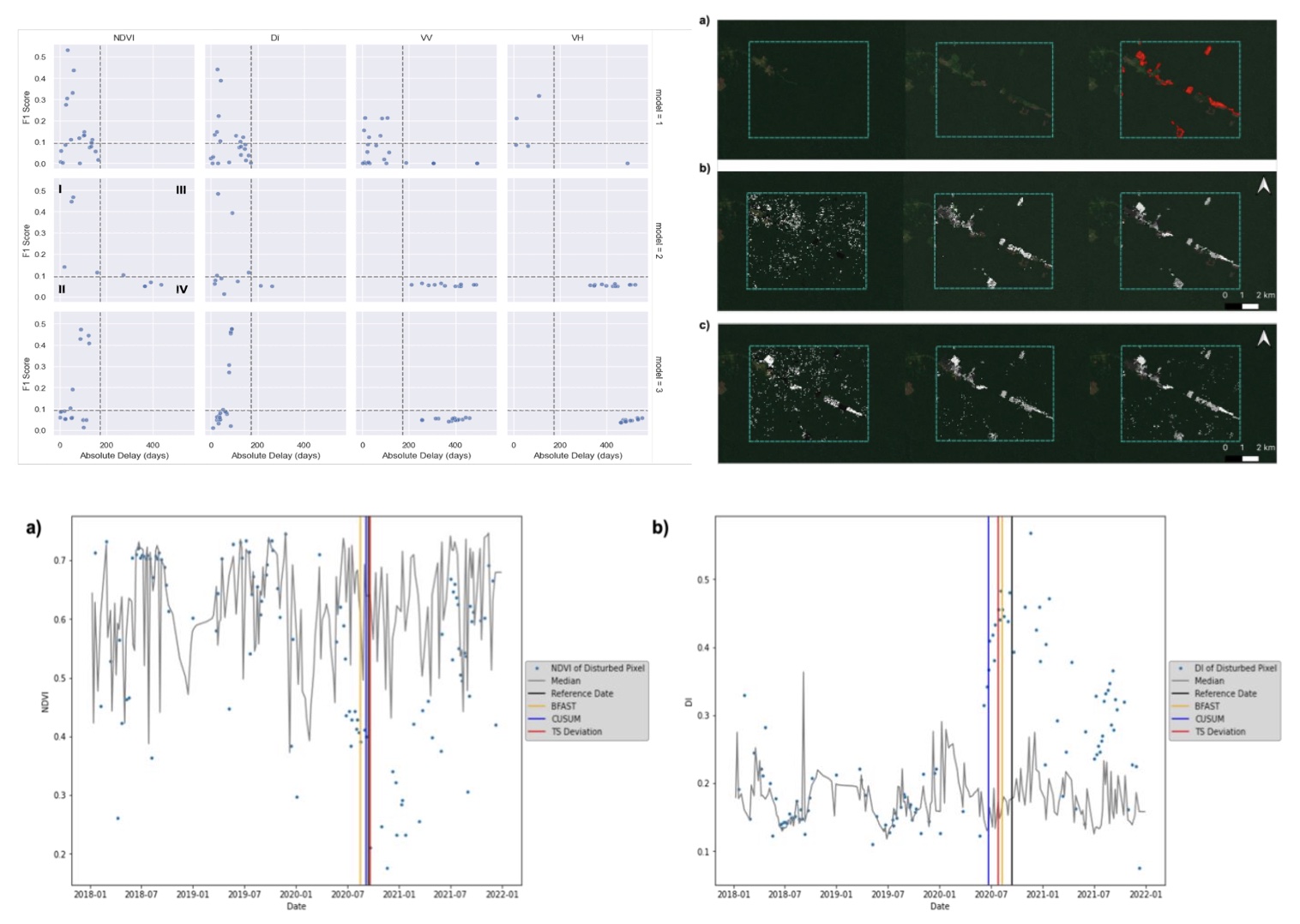
On Tuesday 22nd of November at 1pm we will have the MSc thesis defense by Caroline on “Change Detection using Sentinel-1 and Sentinel-2 Time Series: A Comparison of Models for the Detection of Forest Disturbances.”
from the abstract: “Forests provide essential ecosystem services, such as biodiversity conservation and influencing the global climate system. Increasing frequencies of extreme weather events, as well as human-induced deforestation, pressure these ecosystems and lead to ongoing forest loss at a yearly rate of 4.7 million hectares. Remote sensing has proven to be a crucial tool for analyzing the patterns of these forest loss events at high spatial detail over vast extents. Time series analyses offer means for the early detection of forest disturbances. The goal of this study was to explore the potential of satellite data from optical and radar sources in combination with time series analysis for detecting deforestation in tropical forests. Optical satellite imagery from Sentinel-2 and Synthetic Aperture Radar (SAR) data from Sentinel-1 was applied. Three models combined with two optical vegetation indices and two SAR bands were compared in a benchmarking process. The models applied in this study performed best for the optical Sentinel-2 imagery, specifically the Disturbance Index (DI) combined with the CUSUM model generated the best results. Furthermore, the simpler models CUSUM and time series forecasting based on area-wide averaging showed lower omission errors in the forest loss detection than the more complex BFAST model. While the proposed approaches provide solid methods for deforestation detection in tropical forests, high-quality in- situ measurements from different forest types related to different kinds of disturbance are required for further assessment of the applied methods and data as well as for a more detailed analysis of the underlying drivers of deforestation.”
supervisor: Tobias Ullmann