
On January 14th, Konstantin Müller successfully defended his master’s thesis titled “Animal Path Segmentation and Analysis via Generalized Deep Neural Network Regression”. Supervised by Jakob Schwalb-Willmann and Dr. Mirjana Bevanda, the presentation was delivered to a large audience, followed by an engaging and thought-provoking discussion.
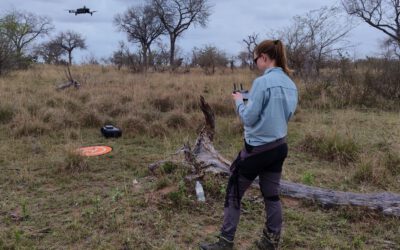
Animals play a vital role in maintaining healthy ecosystems, and understanding their behavior is essential for assessing the health and state of their environment. Animal movements—whether small-scale or extensive—leave traces, such as paths or resting sites, that can provide valuable insights. This study leverages UAV-based RGB data to accurately locate and segment animal paths from an aerial perspective. The proposed approach captures continuous data on animal movements, offering a comprehensive overview of the behaviors of all animals contributing to the movement process.
By focusing on path observation rather than directly monitoring animals, this method avoids challenges associated with traditional tracking methods, such as natural protection regulations or connectivity limitations in remote habitats. The study is primarily applied to the Kruger National Park (KNP), South Africa, where understanding animal behavior is critical for conservation management. The movement patterns derived from animal paths serve as key indicators of habitat utilization and environmental influences, such as droughts.
Building on established line delineation tasks like road segmentation, this research explores the use of convolutional neural networks (CNNs), particularly encoder-decoder architectures, to map animal paths from UAV data. The project addresses three key research questions:
- The impact of ground truth data generation on segmentation accuracy.
- The contributions of network enhancements to improve segmentation performance.
- The generalizability of the model to diverse natural environments.
The findings demonstrate that CNNs can effectively segment animal paths, even in challenging conditions like heavily vegetated or overgrown trails. The networks accurately detect path directions, achieving improved performance through dynamic ground truth generation that estimates individual path widths. Moreover, architectural enhancements, including denser connections and attention modules, increased model accuracy by over 7%.
This research presents an autonomous approach to capturing animal movement patterns through path segmentation, opening new opportunities for further methodological development using advanced neural network techniques and in-depth analysis.
![[spotlight] Lecturer Spotlight: Thilo Erbertseder](https://eagle-science.org/wp-content/uploads/2026/10/Thilo_Lecturer_Portrait_EAGLE_EORC_2026-400x250.jpg)

![[Spotlight] Lecturer Spotlight: Julian Faeth](https://eagle-science.org/wp-content/uploads/2026/10/Julian_Faeth_EORC_EAGLE_2026-400x250.jpg)