On March 19, 2026, Luis David Almeida Famada will present his Master Thesis on ” High-Resolution Seasonal Rangeland Carrying Capacity in Central Asia Using Sentinel-2 and the CASA Model” at 15:00 in seminar room 3, John-Skilton-Str. 4a.High-Resolution Seasonal Rangeland Carrying Capacity in Central Asia Using Sentinel-2 and the CASA Model
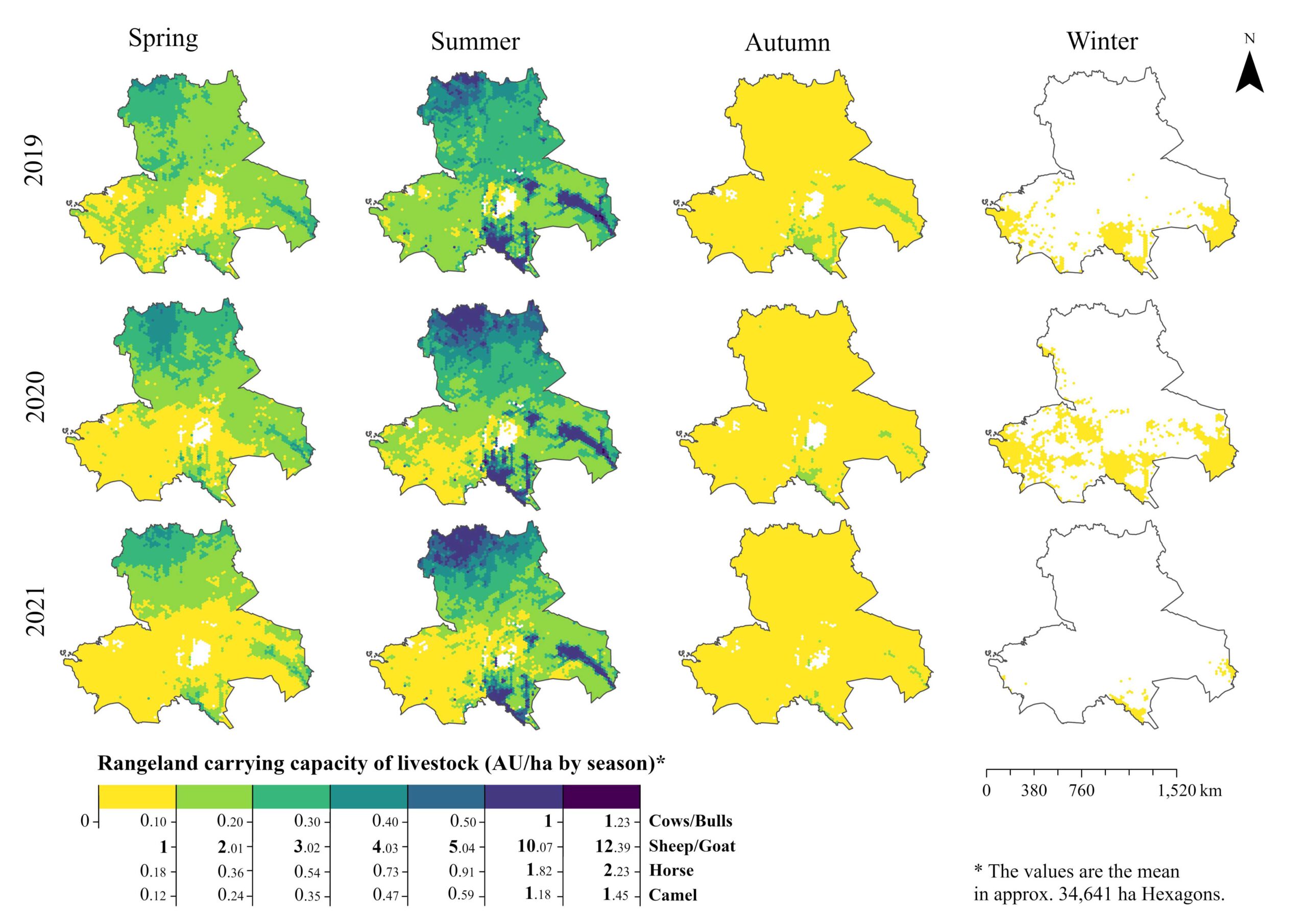
From the abstract: The grasslands of the Aral Sea region support extensive livestock farming but are subject to degradation and increasing grazing pressure. This requires spatially explicit and seasonal estimates of their carrying capacity. This study uses Sentinel-2 multispectral imagery, climate data, and the CASA model to estimate net primary productivity (NPP), above-ground biomass and to derive rangeland carrying capacity (RCC) at a 20-meter resolution for 2021. The modeled forage supply was compared with official livestock statistics at the subregional (rayon) level, converting stocks to Animal Units and calculating an Overgrazing Index (OGI = demand/capacity) and a capacity-demand balance. The results show pronounced seasonality, with peaks in summer and troughs in winter, as well as significant regional variations. The Republic of Karakalpakstan has the most persistent deficits and the highest levels of relative pressure, while Aktobe has surpluses mainly during the growing season (spring– summer). Overall, the findings show that sustainable management in the drylands of Central Asia requires dynamic and seasonal approaches, supported by high-resolution products that allow livestock demand to be synchronized with the spatiotemporal variability of forage supply.
1st supervisor: Prof. Dr. Tobias Ullmann
2nd (external) supervisor: Igor Klein
From the abstract: The grasslands of the Aral Sea region support extensive livestock farming but are subject to degradation and increasing grazing pressure. This requires spatially explicit and seasonal estimates of their carrying capacity. This study uses Sentinel-2 multispectral imagery, climate data, and the CASA model to estimate net primary productivity (NPP), above-ground biomass and to derive rangeland carrying capacity (RCC) at a 20-meter resolution for 2021. The modeled forage supply was compared with official livestock statistics at the subregional (rayon) level, converting stocks to Animal Units and calculating an Overgrazing Index (OGI = demand/capacity) and a capacity-demand balance. The results show pronounced seasonality, with peaks in summer and troughs in winter, as well as significant regional variations. The Republic of Karakalpakstan has the most persistent deficits and the highest levels of relative pressure, while Aktobe has surpluses mainly during the growing season (spring– summer). Overall, the findings show that sustainable management in the drylands of Central Asia requires dynamic and seasonal approaches, supported by high-resolution products that allow livestock demand to be synchronized with the spatiotemporal variability of forage supply.
1st supervisor: Prof. Dr. Tobias Ullmann
2nd (external) supervisor: Igor Klein